Kiwi Spotting on Stewart Island
Kiwi spotting on Stewart Island: how the guided night walk from Oban works, the odds from 205 reviews, the October to April season, what to wear and the local options (Oct 2026).
Kiwi spotting on Stewart Island means a guided walk after dusk in coastal forest where Rakiura tokoeka feed, and the bookable one is RealNZ’s evening encounter from Oban: a boat at dusk, a landing at Little Glory Cove or Oneke, and about four hours in all. It is from US$152 a person, rated 4.8 from 205 reviews (checked October 2026), October to April, for ages 15 and up, and you sleep on the island that night.
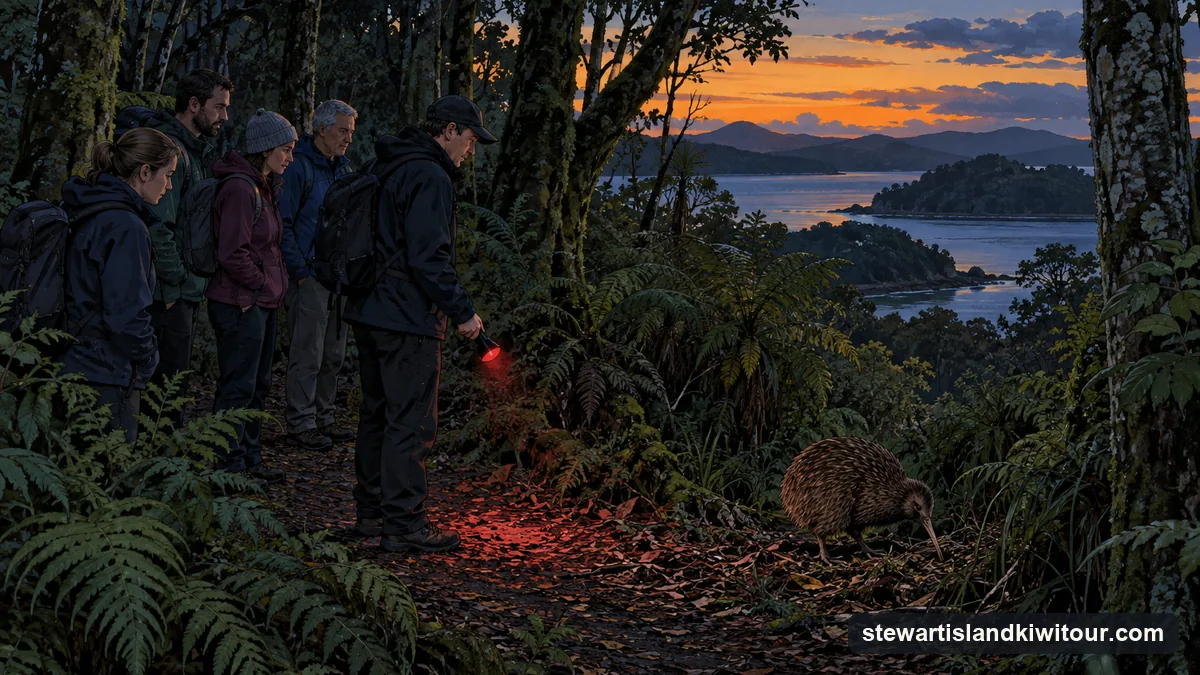
The night, step by step
Check in. Both of RealNZ’s kiwi encounters leave from the main wharf in Oban; check in 30 minutes before. The start is timed to sunset, so it is later in midsummer than in October or April, and the calendar shows the time for each date.
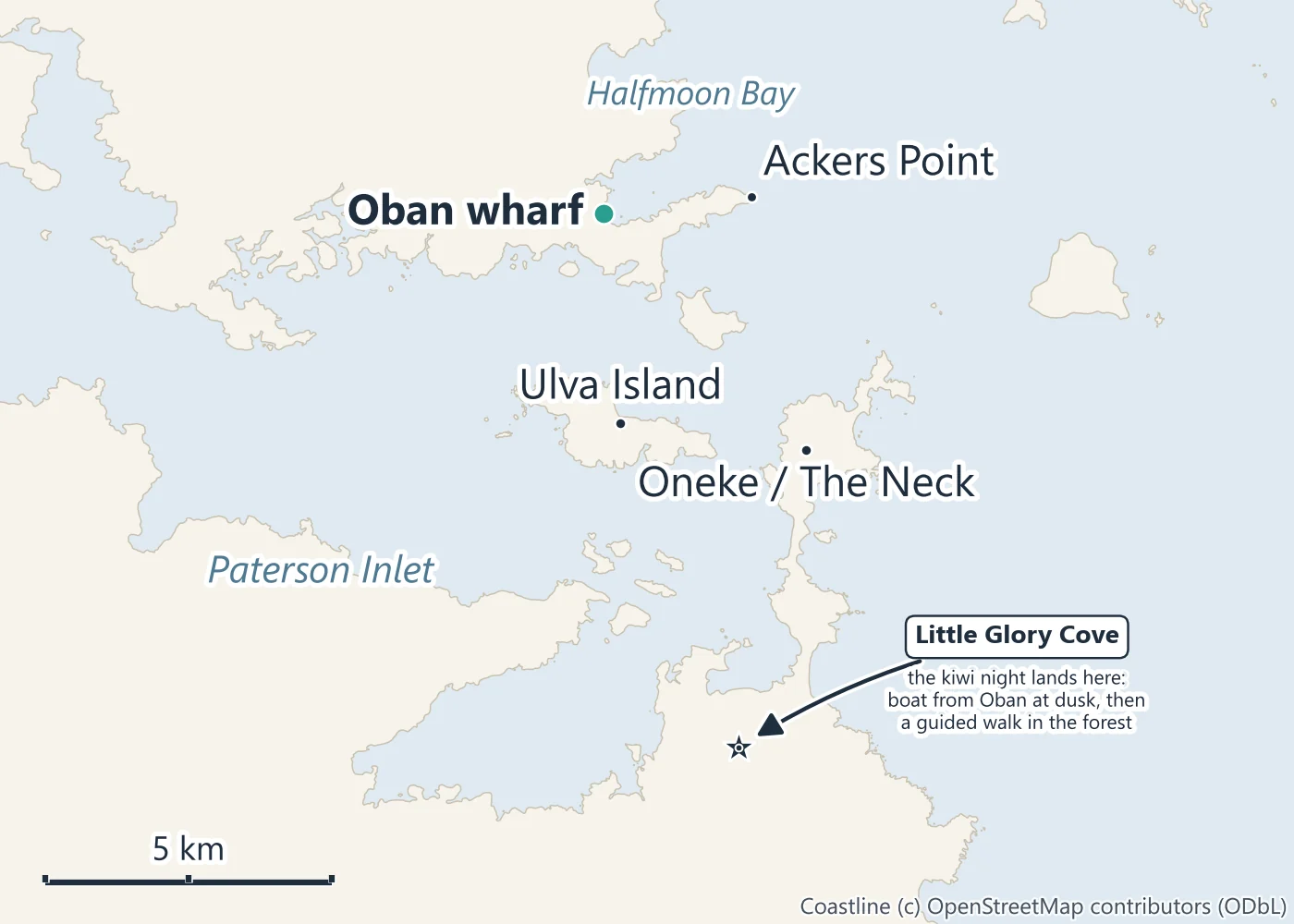
The cruise. On the Rakiura Kiwi and Wildlife Encounter, a cruise of about an hour and a half goes round the islands near Stewart Island, with the guides talking about the tokoeka on board. Tītī (muttonbirds), albatross, yellow-eyed and little penguins and New Zealand fur seals can turn up. The Oneke night goes instead to Oneke, The Neck, a stretch of coast reached only by water, with a welcome and stories in the Oneke whare before dark.
The walk. At Little Glory Cove the group goes ashore as dusk settles and walks through coastal forest and along a quiet sandy beach where the birds come out to feed. You walk slowly behind the guide and keep silent, because a kiwi that hears you goes back into the bush. RealNZ takes up to 20 people a night, split into two groups with a guide each; the GetYourGuide listing limits a booking’s group to 10.
The way back. Hot cocoa, tea or coffee and biscuits, and the cruise back to Oban late at night. RealNZ gives the encounters as at least four hours and says guides may stay out longer when kiwi are about.
The odds
RealNZ says plainly that it cannot guarantee a kiwi and gives no refund for a night without one; if no tokoeka is seen, a donation from the booking goes to pest control and trapping. The reviews give a feel for it. Of the 205 GetYourGuide reviews of this tour, 117 carry text, written between February 2021 and October 2026. Of those, 24 describe seeing at least one kiwi and 8 say the group saw none. The rest praise or criticise the guides, the boat and the other wildlife without saying either way. In short: most nights that reviewers describe found a bird, and a few did not.
Two things move the odds that you control. Wear soft, quiet layers: one three-star review describes a kiwi bolting at the rustle of noisy clothing. And do not book the walk for the evening you arrive, in case the ferry is delayed or cancelled for weather.
Check dates for the kiwi night →
Can't Make These Dates?
Browse More Available Options
Find a tour that fits your schedule. Dates and cancellation terms are on each listing.
Season and timing
RealNZ runs the Little Glory Cove night from October to April and the Oneke night from November to March (checked October 2026); neither runs in winter, when RealNZ says some experiences stop. Wild kiwi are on the island in every season. For the 2026-27 summer, the Little Glory Cove nights run until the end of April 2027.
What to wear and bring
- Shoes. Sturdy walking shoes or boots, not jandals or bare feet. The track is uneven and can be muddy.
- Layers. A warm sweater or fleece and a wind- and waterproof jacket, soft and quiet if you have one. Rakiura’s weather changes fast.
- Torch. If you bring your own, cover it with a red filter or use a red light. DOC asks everyone looking for kiwi on Stewart Island to do this, and not to use bright lights at all.
- Camera. No flash near the kiwi; it is not allowed, and DOC rules it out too.
- Quiet. Keep your voice down and stay on the track behind the guide. DOC asks people to keep to formed tracks so as not to disturb kiwi, and never to stand between a kiwi and the bush.
- Medication. Bring your own, including for asthma and allergies, and tell the guides about relevant conditions.
The encounter is for ages 15 and over. You need to manage uneven ground, steps and natural surfaces for the whole walk.
Kiwi spotting without RealNZ
Oban’s small guiding businesses run kiwi evenings too, booked directly with them rather than here. Ulva’s Guided Walks has exclusive access for kiwi tours to the Mamaku Point Conservation Reserve, about 4 km from Oban and fenced against introduced mammals since 2005: 2 to 3 hours after sunset, groups of ideally 4 to 6, year-round except June, from NZ$155 a person, and not for children under 12 (Ulva’s Guided Walks, October 2026). Ruggedy Range runs an Evening Eco Watch from its office at 14 Main Road. RealNZ on Stewart Island compares them.
Looking without a guide
DOC notes that some Rakiura tokoeka feed in daylight, and it names places where you can look on your own. None of them is a quick evening stroll from Oban:
- Ulva Island, by day. DOC says some visitors catch a rare daytime glimpse of a tokoeka on Ulva Island. Night visits are not allowed and camping is not allowed, so it is a day trip by boat to Post Office Bay. The Ulva Island guide has the rules.
- Mason Bay, on the west coast. DOC calls Mason Bay a popular place to see kiwi in their natural habitat. It lies on the North West Circuit, which DOC describes as challenging multi-day tramping, and at the end of the Freshwater Landing to Mason Bay track, reached by water taxi up the Freshwater River at high tide; the beach can also be reached by plane. Its backcountry huts need Backcountry Hut Tickets or a pass, and the Great Walk huts and campsites on the circuit must be booked before you set off.
- The Rakiura Track. DOC’s Rakiura Track page says there are many kiwi on Stewart Island. It is a Great Walk, and all its huts and campsites must be booked in advance all year round.
- Glory Cove. Glory Cove Scenic Reserve is a kiwi protection area, and a bylaw means you need a permit from the Rakiura National Park Visitor Centre to be there between 6 pm and 6 am.
Wherever you look, DOC’s rules are the same: a red light or red filter on your torch, no flash or spotlights, no closer than 5 m, keep noise down and never surround a kiwi. Looking on your own is still the long way round. The guided night is the surest way to see one: of the GetYourGuide reviews above that say either way, 24 describe a kiwi and 8 do not, and the guides know where the birds feed.
See open nights on the calendar →
The encounters, seasons, check-in, group sizes, inclusions, age limit and sighting policy are from RealNZ’s Rakiura Wild Kiwi Encounters page; the GetYourGuide price, rating, group limit and the review tally from the listing and its 205 reviews, read in US dollars on 30 October 2026; Mamaku Point from Ulva’s Guided Walks; Ruggedy Range from its own site; daytime feeding from DOC’s Rakiura National Park and tokoeka pages; the torch, flash and track rules and the places to look on your own from DOC’s Rakiura Track, Glory Cove Scenic Reserve, Ulva Island, North West Circuit and Freshwater Landing to Mason Bay pages. All read in October 2026.
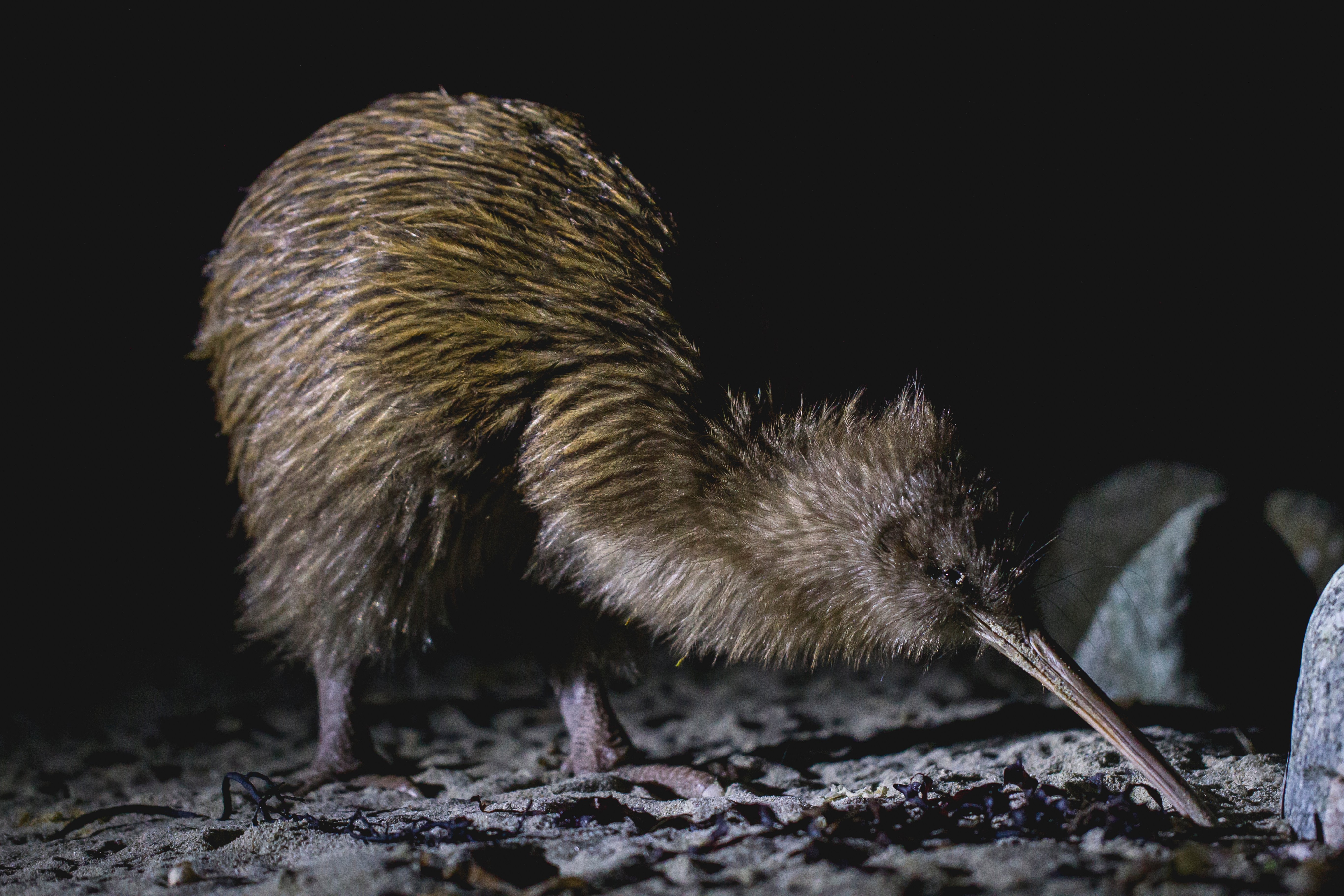
The Rakiura Kiwi Night
A boat from Oban before nightfall, a guided walk by torchlight through coastal forest and along a beach where tokoeka feed, about four hours, groups of up to 10. Ages 15 and up; book a bed on the island. Free cancellation up to 24 hours before, as listed in October 2026.
Check Dates